

Table of Contents
- What Makes a Heavyweight Shirt Different
- Heavyweight vs Lightweight T-Shirt GSM Guide
- Why Heavyweight Fabric Lasts Longer Than Thin Alternatives
- Are Heavyweight Shirts Wearable Year Round? The Honest Answer
- How to Style Heavyweight Shirts for Summer
- Skin Sensitivity, Texture, and the Case for Ring-Spun Cotton
- Heavyweight Shirts Worth Wearing Every Season
- Conclusion
Last Updated: August 25, 2026
What Makes a Heavyweight Shirt Different
Heavyweight shirts are constructed from fabric weighing 6 ounces per square yard or more, giving them a noticeably denser, more substantial feel than thin cotton jerseys. That density changes how the shirt drapes, holds its shape after washing, and performs across different temperatures.
At Dark Times Rebellion, we build every shirt around this standard because lightweight fabric telegraphs cheapness the moment you put it on. A heavyweight tee hangs with authority. It doesn't cling, go translucent in the sun, or pill after six washes. The weight number alone doesn't tell the full story, fiber composition, ring-spinning method, and garment construction all interact with GSM to determine how a shirt actually performs on your body.
GSM, Fabric Density, and What the Numbers Mean
GSM stands for grams per square meter. It is the textile industry's standard unit for measuring fabric weight and density. A higher GSM means more fiber packed into each square meter of cloth, translating directly to thickness, opacity, and structural integrity.
Most mass-market t-shirts land between 130 and 160 GSM. Premium midweight shirts typically run 180 to 200 GSM. True heavyweight fabric starts at 200 GSM and can climb to 280 GSM or higher. The ASTM International textile testing standards provide the framework most manufacturers use to measure and verify these values consistently.
The practical difference between a 150 GSM shirt and a 200+ GSM shirt is immediate. The heavier fabric resists stretching at stress points, holds collar shape through repeated washing, and maintains opacity even when damp.
Fiber Composition and How It Changes Everything
GSM sets the weight, but fiber composition determines the character of that weight. Two shirts can share the same GSM and feel completely different.
100% ring-spun cotton at 200+ GSM is the benchmark for premium heavyweight shirts. Ring-spinning combs the cotton fibers into alignment before twisting them, producing yarn that is stronger, smoother, and more uniform than carded cotton. The result is fabric with better tensile strength, softer hand-feel, and improved wash-fastness over time.
Carded cotton leaves shorter fibers in the yarn, feels rougher against skin, and begins to pill after a few washes. Blends incorporating polyester add moisture-wicking and reduce shrinkage, but they also reduce breathability and natural thermal regulation. For year-round wearability, 100% ring-spun cotton remains the most versatile choice.
Heavyweight vs Lightweight T-Shirt GSM Guide
The table below maps fabric weight to real-world performance so you can match the right shirt to the right use case.
Weight Category |
GSM Range |
Typical Feel |
Best Season |
Durability |
|---|---|---|---|---|
Lightweight |
130-160 GSM |
Thin, soft, drapes loosely |
Summer only |
Low-moderate |
Midweight |
160-200 GSM |
Balanced, versatile |
Spring/Fall |
Moderate |
Heavyweight |
200-230 GSM |
Substantial, structured |
All-season |
High |
Ultra-heavyweight |
230+ GSM |
Dense, stiff initially |
Fall/Winter |
Very high |
The 200-230 GSM range is the sweet spot for year-round wearability. It's heavy enough to provide warmth in transitional weather and retain structure, but not so dense that it becomes uncomfortable in warmer months. The Cotton Incorporated fiber research on ring-spun performance supports ring-spun construction at this weight range as the most durable configuration for everyday cotton jersey.
Lightweight shirts under 160 GSM lose shape, go translucent, and rarely survive more than a year of regular washing before the fabric thins to near-transparency.
Why Heavyweight Fabric Lasts Longer Than Thin Alternatives
When fabric is thin, stress concentrates at specific points: collar seams, armholes, the area below the neckline. With fewer fibers to distribute that stress, thin fabric fails faster.
Heavyweight cotton distributes mechanical stress across more fibers per square centimeter. The collar holds its shape instead of stretching out. The body resists pilling because there's simply more material to work with. Wash-fastness improves because dye penetrates deeper into a denser weave, meaning colors stay truer longer.
Durability is a function of GSM, fiber type, and stitching, not brand name. Get all three right and the shirt outlasts anything built on a 150 GSM blank.

Construction Quality: Stitching, Collars, and Hems
Fabric weight is only half the durability equation. Garment construction determines whether that fabric survives years of real use.
Quality construction markers are specific and verifiable: a double-needle topstitched collar resists stretching and maintains shape through repeated washing. Twill-taped neck and shoulders add structural reinforcement at the highest-stress seam. Double-needle armhole, sleeve, and bottom hems prevent unraveling where single-stitch construction typically fails first.
The Hope is Forged tee from Dark Times Rebellion, for example, is built on a 6.1 oz/yd² (approximately 207 GSM) ring-spun cotton blank with a 7/8-inch double-needle topstitched collar and twill-taped neck and shoulders. Single-needle stitching saves manufacturers money but costs customers durability.
Are Heavyweight Shirts Wearable Year Round? The Honest Answer
Yes, with one qualification: the answer depends on your climate, layering habits, and the specific GSM of the shirt. A 220 GSM ring-spun cotton tee is genuinely all-season in most climates. A 280 GSM ultra-heavyweight shirt is a cold-weather piece that will feel oppressive in July heat.
Thermal Properties in Cold Weather
Heavyweight cotton's thermal properties come from its density. More fiber per square meter means less air movement through the fabric, translating to better heat retention against the body. In cold weather, a 200+ GSM cotton tee worn as a base layer traps warmth effectively without the bulk of synthetic thermal layers.
A heavyweight tee sits close to the body, retains warmth, and provides a stable foundation for a flannel, hoodie, or jacket over the top. Because the shirt has structural integrity, it doesn't bunch or shift under outerwear. According to the Textile Research Journal on natural fiber thermal properties, natural cellulosic fibers like cotton provide meaningful insulation at higher fabric densities.
Breathability and Climate Control in Warmer Months
Pure ring-spun cotton breathes through moisture management, it absorbs moisture vapor from the skin and releases it through the fabric, keeping the wearer cooler than a synthetic shirt of equivalent weight.
The key variable is air circulation. A relaxed fit or slightly oversized silhouette in a heavyweight cotton shirt creates space between fabric and skin, allowing air movement that a tight-fitting thin shirt restricts. In moderate summer heat, a well-cut heavyweight tee is often more comfortable than a clingy lightweight alternative.
In dry climates, heavyweight cotton performs well year-round because moisture evaporates quickly. In high-humidity climates above 90°F, any shirt becomes challenging, but the right heavyweight cotton shirt remains wearable in most real-world warm-weather conditions.
How to Style Heavyweight Shirts for Summer
Styling heavyweight shirts for summer is less about fighting the fabric weight and more about working with the silhouette. The structured drape creates a cleaner, more intentional look than the limp hang of a lightweight alternative.
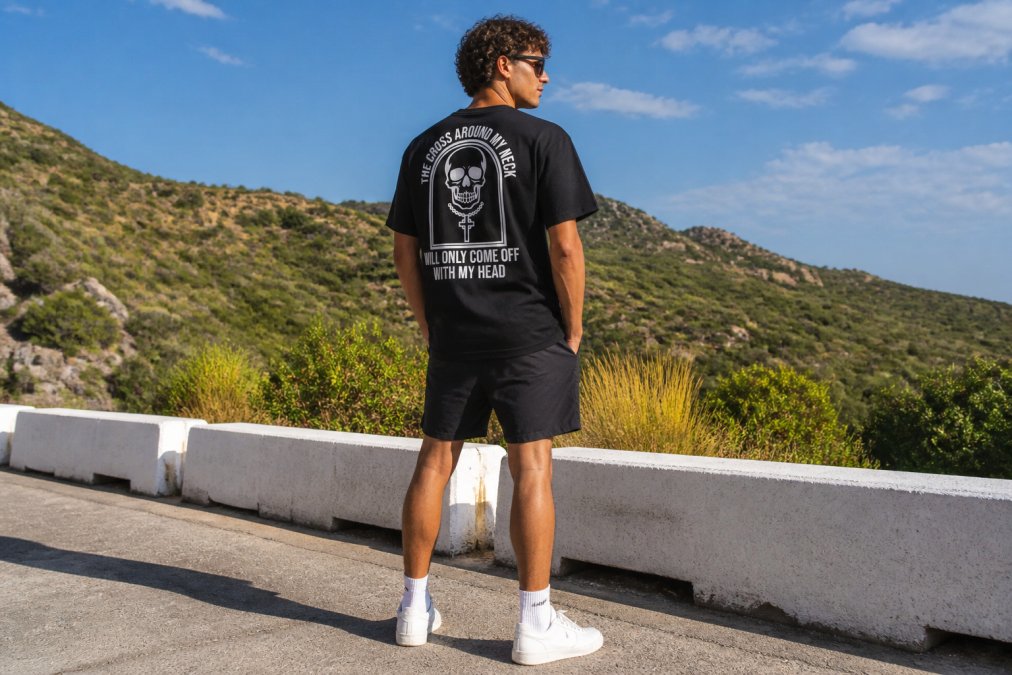
The relaxed fit that many heavyweight shirts are cut in is an asset in summer. It keeps fabric off the body, promotes air circulation, and creates a clean silhouette that reads as intentional. Pair a heavyweight graphic tee with lightweight shorts and clean footwear and the contrast works in your favor.
A few practical approaches:
- Go one size up if you're between sizes. The slightly boxier cut reduces contact with skin and improves airflow.
- Stick to lighter colorways for peak summer. A seafoam green or grey heavyweight tee absorbs less solar radiation than black.
- Tuck the front loosely. A half-tuck on a heavyweight tee with a clean hem creates a styled look that improves ventilation.
- Wear it as the anchor piece. A heavyweight graphic tee with strong design doesn't need layering to look complete.
Black heavyweight shirts remain wearable in summer with the right approach: shade, airflow, and a relaxed fit.
Skin Sensitivity, Texture, and the Case for Ring-Spun Cotton
For anyone with skin that reacts to rough fabric, the difference between ring-spun and carded cotton is the difference between a shirt they wear constantly and one that sits in a drawer.
Ring-spun cotton is softer because the spinning process removes short, rough fibers and aligns the remaining fibers in parallel. The surface is smoother and more uniform, meaning less friction against skin. As documented by the American Academy of Dermatology on fabric and skin irritation, natural fiber content and surface texture are primary factors in contact dermatitis and general skin comfort.
Carded cotton retains short fibers, creating a rougher surface that becomes more pronounced as the fabric ages and pills. For everyday wear, especially in warm weather, ring-spun cotton at heavyweight GSM is the clear choice for comfort.
Garment-dyeing also affects texture. Garment-dyed shirts are dyed after construction, producing a softer, slightly weathered hand-feel that many find more comfortable than piece-dyed alternatives.
Heavyweight Shirts Worth Wearing Every Season
The question of year-round wearability resolves quickly when you look at shirts built to a genuine specification rather than a price point. Shirts worth wearing across all four seasons share the same fundamentals: ring-spun cotton at 200+ GSM, reinforced seams, and a cut that works with the fabric weight.

The Martyr Heavyweight Christian Warrior T-Shirt from Dark Times Rebellion is built around exactly this standard. Available in black and seafoam green, both at $30, it carries the construction quality that makes year-round wear practical. The black version holds its depth of color through repeated washing. The seafoam green is a summer-viable colorway that reflects more light and keeps the shirt cooler in direct sun.

The Hope is Forged Premium T-Shirt in grey adds a third colorway at the same price point, built on a 6.1 oz/yd² ring-spun cotton blank with full double-needle construction throughout. Grey is arguably the most versatile colorway for year-round wear: it pairs with virtually anything and shows less wear between washes than black.
Shirt |
GSM |
Colorway |
Best Season Fit |
Price |
|---|---|---|---|---|
Martyr Tee - Black |
200+ |
Black |
Fall/Winter/Spring |
$30 |
Martyr Tee - Sea Foam Green |
200+ |
Sea Foam Green |
Spring/Summer |
$30 |
Hope is Forged Tee - Grey |
~207 |
Grey |
All-season |
$30 |
What separates these from cheaper Christian apparel options is construction. A shirt that falls apart after a year isn't a wardrobe staple. It's a one-time purchase that fails the wearer and fails the mission it's supposed to carry.
Frequently Asked Questions
Are heavyweight shirts good for summer?
Yes, with the right fiber and fit. A 100% ring-spun cotton heavyweight shirt in a relaxed or oversized cut allows enough air circulation to stay comfortable in warm weather. The key is fabric composition — natural cotton fibers breathe better than synthetic blends. Garment-dyed finishes also help the fabric soften over time, which improves comfort against skin. Sizing up slightly and keeping the silhouette loose makes a 6 oz shirt genuinely wearable through warmer months.
Do heavyweight tees shrink more than lightweight ones?
Heavyweight tees can shrink on the first wash if they're not pre-shrunk or garment-dyed. Garment-dyeing — a process that washes the finished shirt before it reaches you — removes most of the shrinkage risk upfront. After that first wash, a quality heavyweight shirt holds its shape far better than a thin alternative because the denser fabric structure resists distortion. Wash in cold water and air dry or tumble dry low to preserve the fit long term.
What is the ideal GSM for a year-round heavyweight t-shirt?
For true year-round wearability, a GSM between 200 and 220 grams per square meter hits the best balance. That range is heavy enough to hold its structure, resist pilling, and provide light thermal comfort in cooler weather, but not so thick that it becomes stifling in summer. The Martyr Tee and Hope is Forged shirt from Dark Times Rebellion sit right in this range at 6.1 oz/yd², making them practical across all four seasons.
Why does heavyweight fabric last longer than thin alternatives?
Fabric density is the core reason. A higher GSM means more fibers packed per square centimeter, which increases tensile strength and resistance to tearing, pilling, and wash-related breakdown. Thin shirts lose their shape after repeated washing because there are fewer interlocked fibers to hold structure. Heavyweight cotton also holds dye better, so colors stay truer longer. Pair that density with double-needle stitching at the collar, sleeves, and hem, and the garment holds together through years of regular wear.