

Table of Contents
- What Ethical Christian Clothing Production Actually Means
- Biblical Principles of Business Ethics That Guide Ethical Production
- How Ethical Christian Clothing Production Protects Garment Workers
- Sustainable Materials and Eco-Friendly Manufacturing in Christian Apparel
- How to Verify Ethical Clothing Production Before You Buy
- Stewardship in Fashion Consumption: A Cost-Benefit Look
- Conclusion
- Frequently Asked Questions
Last Updated: October 1, 2026
What Ethical Christian Clothing Production Actually Means
Ethical Christian clothing production honors biblical values at every stage of the supply chain, from cotton field to finished garment, treating fair labor, honest sourcing, and environmental care as moral obligations rather than marketing extras. For believers, the benefits of ethical christian clothing production reach the garment worker, the community, and the witness a Christian leaves in the marketplace.
This guide breaks down those benefits in practice, and how to spot real ethical production versus a good story on a hangtag.
Most apparel today moves fast and cheap, and the pressure to cut costs lands hardest on the people sewing it. Ethical production flips that logic: it slows the process down, pays attention to who makes the clothing and how, and refuses to let human dignity become a line item to trim.
That distinction matters for anyone who takes their faith seriously. Faith-based consumerism is not about buying nothing; it is about buying with intention, understanding that every purchase is a small vote for the kind of economy you want to support.
Biblical Principles of Business Ethics That Guide Ethical Production
Biblical principles of business ethics start with a simple premise: people are not tools. Scripture ties fair treatment of workers to the character of God and warns against withholding wages or exploiting the vulnerable for profit. What most treatments skip is the step in between, how an ancient agrarian passage becomes a factory audit, a wage floor, or a purchasing decision in 2026.
That translation step is where the benefits of ethical christian clothing production become concrete. Here is how the major biblical mandates map onto modern supply chain practice.
"The laborer is worthy of his hire" (Luke 10:7; 1 Timothy 5:18). This is not about generosity; it is about what wages are owed. In apparel terms, it is the difference between a legal minimum wage and a living wage, what a worker actually needs for housing, food, healthcare, and modest savings in their region. The gap is widest in the cut-and-sew tier, where the sewing happens. A brand that takes this verse seriously must answer: what is the wage floor at each factory, and how was it calculated?
"You shall not withhold the wages of a hired worker" (Deuteronomy 24:14-15; James 5:4). The mechanism here is payment timing and subcontracting. When a brand pays a factory late, workers get paid late or not at all; when it uses unnamed subcontractors, it cannot know whether wages were paid. That is why a published, tiered factory list, assembly plant, fabric mill, and dye house, is a biblical-ethics issue, not just a PR one.
"Honest scales" (Leviticus 19:35-36; Proverbs 11:1). In modern terms, this is truth in labeling. A garment called "organic" when only the trim is organic, or "made ethically" with no named factory, is a dishonest scale. The Federal Trade Commission's Green Guides exist because such claims are common enough to need regulation. Scripture asks for more than compliance, claims that would survive scrutiny from the person who made the garment.
Human dignity (Genesis 1:27; James 5:1-6). Dignity is the hardest principle to audit because it is qualitative. Brands that take it seriously look at building safety, heat and ventilation, bathroom access, break time, and whether workers can raise a grievance without retaliation, items that show up in a credible social audit and almost never on a marketing page.
Stewardship of creation (Genesis 2:15; Psalm 24:1). This ties labor ethics to environmental ethics: a brand cannot honor the worker while poisoning the water the worker drinks. Fiber choice, dye chemistry, and wastewater treatment are moral questions, not just sustainability talking points.
- Fair labor and living wage. Workers are paid enough to meet their basic needs, not just the legal minimum, and the brand can show the math.
- Honest scales. Pricing, sourcing claims, and materials are described truthfully, without exaggeration.
- Human dignity. No forced labor, no child labor, no unsafe conditions treated as acceptable overhead.
- Supply chain transparency. A brand can name its factories, tier by tier, and explain how it audits them.
- Creation care. Environmental practices are treated as part of the same moral obligation as labor practices, not a separate marketing track.
The U.S. Department of Labor guidance on supply chain labor practices frames many of these obligations in legal terms, but Scripture frames them in moral ones. A business can be fully compliant and still fall short of biblical stewardship. Compliance is the floor, not the ceiling.
This is where most brands quietly fail: they meet the legal standard, publish a values page, and stop. Biblical business ethics asks for more, a willingness to accept lower margins so a worker keeps their dignity, and the discipline to document that choice so a customer can verify it.
How Ethical Christian Clothing Production Protects Garment Workers
Ethical Christian clothing production protects garment workers by treating their safety, wages, and dignity as non-negotiable rather than costs to push down. That protection shows up in audited factories, fair pay, and refusing to source from operations that rely on labor exploitation.
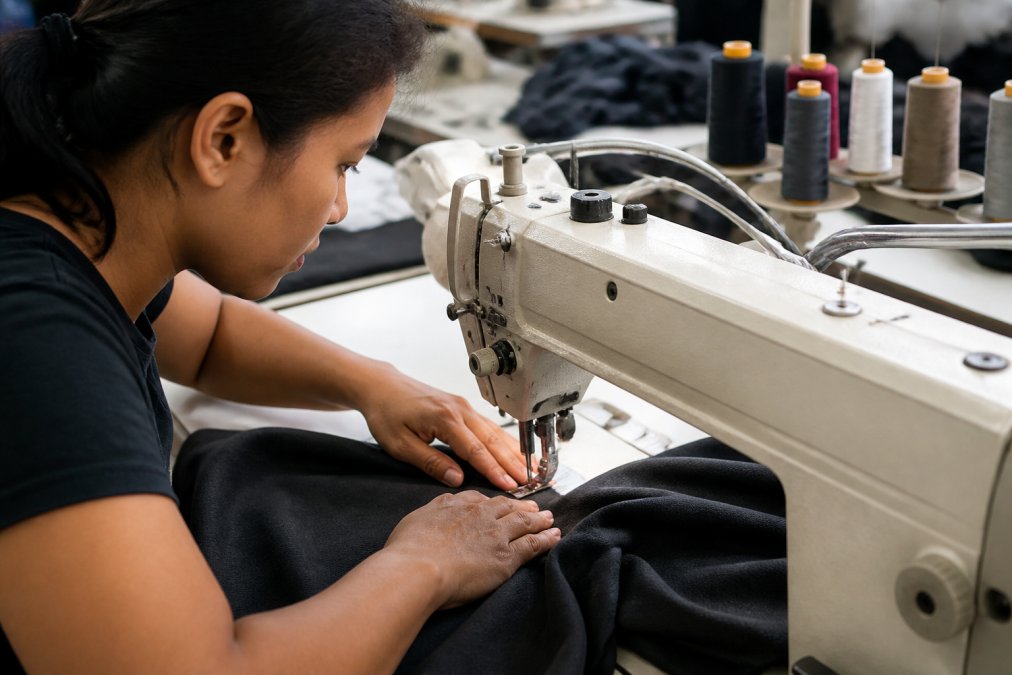
The global garment industry has a long history of labor exploitation, and modern slavery still exists in textile supply chains.
What to look for in a genuinely worker-first brand:
- Published factory lists, not vague "partner facilities" language
- Independent third-party audits rather than self-reported claims
- A stated wage policy that goes beyond the legal minimum
- Long-term relationships with suppliers instead of constant cost-driven switching
Sustainable Materials and Eco-Friendly Manufacturing in Christian Apparel
Sustainable materials and eco-friendly manufacturing reduce the environmental toll of clothing, and for Christian apparel brands they carry theological weight: creation care is part of stewardship, and material choices say something about how a brand views the world it was given.
How to Verify Ethical Clothing Production Before You Buy
You verify ethical clothing production by demanding specifics: named factories, third-party certifications, and a readable wage policy. Vague promises do not count. Here is a practical pre-purchase checklist.
- Does the brand publish its factory list with locations?
- Are certifications named and verifiable, not just implied?
- Is there a stated wage policy, beyond "fair wages"?
- Does the brand describe how it audits suppliers?
- Can you find the material origins, not just the final assembly country?
- Does the brand explain what happens to garments at end of life?
| What to Check | Red Flag | What Good Looks Like |
|---|---|---|
| Factory disclosure | "Our trusted partners" | Named factories with locations |
| Certifications | Unnamed "eco" claims | GOTS, Fair Trade, or similar |
| Wage policy | "Competitive pay" | Stated living-wage commitment |
| Auditing | No mention | Third-party audits described |
| End of life | Ignored | Take-back or repair options |
Stewardship in Fashion Consumption: A Cost-Benefit Look
Stewardship in fashion consumption means weighing what you spend against what it supports, honestly and within your actual budget. It is not a call to buy the most expensive option; it is a call to buy deliberately and do the arithmetic instead of trusting the slogan.
-
High-frequency basics (undershirts, everyday tees, work pants, socks): spend up. These are the items where durability pays back fastest.
-
Mid-frequency items (a good button-down, a versatile sweater): spend mid. Look for sales, end-of-season, and seconds.
-
Low-frequency items (a formal outfit, a seasonal coat in a mild climate): buy used, borrow, or buy cheap. The cost-per-wear math does not justify a premium here.
-
Cost per wear beats sticker price as a measure of value. Do the division before you buy.
-
Fewer, better pieces in the categories you wear most reduce both spending and waste over time.
-
Care and repair extend a garment's life and stretch every dollar further.
-
Secondhand first for low-frequency items keeps money in your pocket and clothing out of landfills.
Conclusion
The gap between what brands claim and what they do is the real challenge in ethical Christian clothing. Closing it takes buyers who ask hard questions and brands willing to answer with documentation, not slogans.
Frequently Asked Questions
Why should believers prioritize ethical brands over fast fashion?
Fast fashion relies on labor exploitation and environmental damage that contradict biblical values of human dignity and stewardship. Choosing ethical Christian clothing production supports fair labor, reduces waste, and aligns your spending with your faith. It also sends a message that you value people over profit, reflecting the moral obligation to love your neighbor as yourself.
How does ethical production align with Christian stewardship?
Stewardship means managing God's resources responsibly. Ethical Christian clothing production uses sustainable materials, pays living wages, and reduces environmental impact. This reflects stewardship in fashion consumption by treating workers, communities, and the planet with respect. When you buy from brands that prioritize fair labor and supply chain transparency, you participate in that stewardship.
What does the Bible say about fair labor and treatment of workers?
Scripture repeatedly commands fair treatment of workers. Deuteronomy 24:14-15 says not to withhold wages from the poor and needy. James 5:4 warns against unpaid wages crying out to God. These verses form the biblical principles of business ethics that guide ethical Christian clothing production. Brands that pay living wages and ensure safe conditions are honoring these commands.
How can consumers identify truly ethical Christian clothing brands?
Look for specific certifications like GOTS for organic cotton and Fair Trade. Check if the brand publishes its supply chain, names its factories, and shares audit results. Ask about how to verify ethical clothing production: a transparent brand will answer directly. Avoid vague claims like 'eco-friendly' without proof. If a brand cannot explain where and how its clothes are made, treat that as a red flag.