

Table of Contents
- What Makes Christian Streetwear Feel Preachy
- How Modern Christian Streetwear Design Has Evolved
- A Modern Christian Streetwear Style Guide
- How to Find the Best Christian Streetwear Brands
- Balancing Bold Faith and Everyday Style Without Being Preachy
- Frequently Asked Questions
Last Updated: September 11, 2026
What Makes Christian Streetwear Feel Preachy
Christian streetwear stops feeling preachy the moment the garment carries a message instead of shouting one. The difference comes down to text volume, tone, and whether the design assumes the wearer is performing for an audience.
This guide from Dark Times Rebellion examines where that line sits and how to carry conviction without turning every coffee run into a sermon.

Most people who ask whether christian streetwear is too preachy have already seen the worst version: a shirt with a full paragraph of Scripture across the chest, a hoodie that reads like a church sign. The instinct to react against that is correct, not cynical.
Slogan-Heavy Graphics and the Cringe Factor
The cringe reaction is almost always a design problem, not a faith problem.
Slogan-heavy graphics fail because they treat the shirt as a billboard. When text runs six or eight words deep, the wearer becomes a walking poster, and viewers read the message before they see the human.
Three patterns reliably trigger it:
- Text that addresses the viewer directly with a command
- Copy that implies moral superiority over whoever reads it
- Designs where the message overwhelms the garment itself
When Bold Messaging Crosses Into Performance
Bold messaging crosses into performance when the design's first job is to be seen by others rather than worn by the wearer.
There is nothing wrong with a strong statement, the Martyr Heavyweight Christian Warrior T-Shirt exists precisely because conviction is not soft. What separates it from performance is intent: a declaration worn for the wearer reads differently than one worn at the room.

Here is the practical test. If you would still wear the piece alone in your own house, it is a garment. If you would only wear it where people will notice, it is a costume.
How Modern Christian Streetwear Design Has Evolved
Modern Christian streetwear has moved from slogan-first to design-first, mirroring the broader streetwear shift toward small marks on well-cut garments. That is why the "too preachy" question is worth asking: the category has evolved, and today the strongest pieces are not.
From Slogan Shirts to Subtle Design
Subtle design wins because it respects the viewer's intelligence. A cross woven into typography does more work than a sentence explaining the cross, and a single word placed well outperforms a paragraph placed badly. That is why the pieces that age best tend to be the quietest ones.
The Dark Times Rebellion Premium T-Shirt is a good example of the approach. Bold typography on the back, a cross built into the layout, and a small DTR mark on the front. It says who you stand with without narrating it.

The Design Psychology Behind Message-Driven Apparel
Design psychology explains why subtle pieces outperform loud ones. It comes down to four visual cues most buyers feel but never name.
Typeface. A heavy condensed sans-serif in all caps reads as a command, the visual grammar of protest signs and warning labels. A humanist serif, lowercase script, or a single letterform treated as a mark reads as a signature. Same words, opposite emotional register.
Scale and text-to-garment ratio. When the printed area covers more than about a third of the front panel, the shirt stops being clothing and starts being a surface. Below that threshold the graphic reads as decoration; above it, as a demand for attention. That is why a chest-width logo feels calm and a full-front paragraph feels aggressive, even with an identical message.
Color contrast. High-contrast text on a dark ground, pure white on jet black, maximizes legibility and the sense that the wearer wants to be read from across the room. Lower-contrast treatments, tonal prints, or graphics that only resolve up close reward proximity instead of demanding it.
Placement. Front-and-center at eye level is confrontational by default because it meets the viewer's gaze. Back prints, sleeve marks, hem hits, and small left-chest placements let the wearer choose when to reveal the message: a back print is a statement you turn around to share, a front print one you push at people.
People process visual symbols faster than language. A cross registers instantly; a six-word slogan has to be read, parsed, and judged before the reader has any relationship with the wearer. Symbols invite curiosity, sentences invite argument, and a design a viewer cannot fully decode gives them a reason to ask, which beats a statement they can dismiss without speaking.
What This Means for Buyers
You do not need a design degree to apply this. Ask four questions of any piece: Is the typeface shouting or signing? Does the print cover more than a third of the front? Is the contrast built for across-the-room or up-close reading? Is the message pointed at the viewer or carried by the wearer? Four calm answers mean a piece you will wear for years; three loud ones mean it ends up at the back of the drawer by month two.
A Modern Christian Streetwear Style Guide
Building a modern christian streetwear style guide starts with one rule: the message is one element in the outfit, not the entire outfit. Treat the graphic tee as the anchor and let everything around it do quiet work.
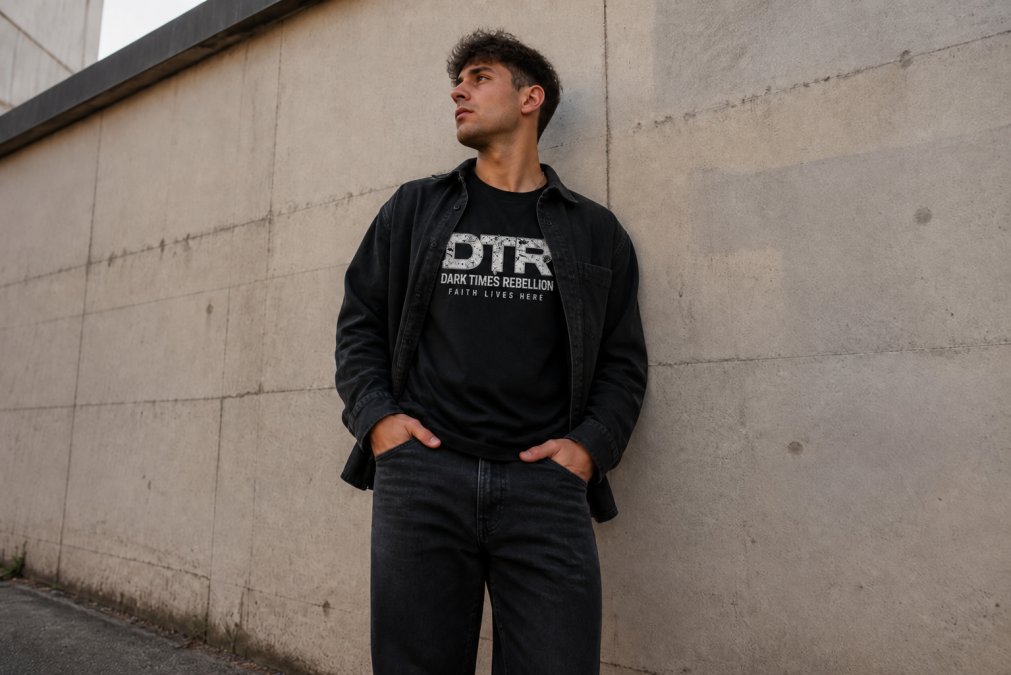
Building Outfits Around Graphic Tees
Graphic tees carry an outfit when the surrounding pieces stay neutral. Start with fit: a heavyweight tee sits better under an overshirt or jacket than a thin one, and the 6.1 oz/yd² fabric weight on these pieces holds its shape through a full day. Keep the palette tight, black tee, dark denim or cargos, one outer layer, one clean pair of shoes, and the graphic becomes the focal point.
Two combinations that consistently work:
- Heavyweight black tee, open flannel or overshirt, straight-leg denim, low-profile sneakers
- Grey garment-dyed tee, black joggers or tapered cargos, trucker hat, clean canvas shoes
Layering and Accessorizing Faith-Based Apparel
Layering is where most people overdo it. Adding more faith-coded pieces is exactly what pushes an outfit from elevated to preachy. One message per outfit: if the tee carries the statement, the hat should be plain or carry a mark rather than a second slogan.
Accessories should support, not repeat:
Layer |
Do This |
Avoid This |
|---|---|---|
Outer layer |
Open overshirt, flannel, or jacket |
Second graphic layer over the tee |
Headwear |
Plain or single-mark cap |
Second slogan competing with the shirt |
Footwear |
Clean, neutral, low-profile |
Loud color that fights the graphic |
Jewelry |
One simple piece, cross or plain chain |
Stacked religious pendants |
How to Find the Best Christian Streetwear Brands
The best christian streetwear brands treat apparel quality and design restraint as non-negotiable. Message alone is not a brand; it is a print on a blank. A brand that treats the garment as an afterthought produces shirts that look sharp in photos and fall apart by month three.
Quality, Fit, and Ethical Manufacturing
Quality shows up in specifics you can check before buying: fabric weight in ounces per square yard rather than vague "premium cotton" claims, construction details like double-needle stitching at the collar, twill-taped neck and shoulders, and reinforced hems, plus a real size chart with measured chest width and body length. Fit is the second filter, a relaxed fit that runs true to size solves the category's most common complaint, inconsistent sizing.
Ethical Manufacturing: The Signals That Actually Hold Up
Ethical manufacturing is the hardest claim in apparel to verify, and most faith-based brands handle it badly, staying silent or using language that sounds meaningful and commits to nothing. "Ethically made" and "responsibly sourced" are marketing phrases, not standards. Look for these signals instead.
A named production model. Made-to-order production, where a garment is printed or sewn only after an order is placed, is one of the few claims a small brand can back up. It reduces unsold inventory and waste, and is verifiable in a way a vague ethics statement is not. Print-on-demand is related, but usually means the brand never touches the blank.
A named blank supplier. Ask which mill or blank manufacturer the shirt comes from. Brands that use well-known wholesale blanks can name them, and that name tells you the fabric weight, the country of origin, and the construction standard before you buy. A brand that cannot or will not name its blank is usually buying on price alone.
A published supply chain, even a short one. You do not need a full audit report, just a brand that can answer three questions in plain language: Where is the blank made? Where is it printed or finished? Who does that work? A brand that answers all three has thought about it; one that answers none has not.
Certifications, used honestly. Third-party textile certifications are worth checking when a brand cites one by name. The tell is specificity: naming a certification and explaining what it covers signals real diligence, while gesturing at "sustainable practices" signals a marketing deck.
A stated trade-off. Honest brands admit what they have not solved: made-to-order means longer shipping windows, small-batch production means higher per-unit cost. A brand that acknowledges those trade-offs is more credible than one claiming to have solved everything at once.
None of this requires trusting a brand's values statement. It requires asking questions a values statement cannot dodge.
Why This Matters More in Faith-Based Apparel
A brand built on conviction makes an implicit promise about how it operates, not just what it prints. When that promise is backed by a named blank, a stated production model, and a describable supply chain, the garment and the message line up. When it is not, the shirt is a slogan with a logo on it, and buyers notice.
Balancing Bold Faith and Everyday Style Without Being Preachy
Balancing bold faith with everyday style comes down to context. The same shirt that lands at a small group can feel heavy at a family dinner, that is not hypocrisy, it is reading the room. The practical framework is a tiered wardrobe rather than a single boldness setting.
Tier 1: Everyday pieces. Subtle marks, single words, cross motifs built into typography. These work at work, at the store, anywhere. The Dark Times Rebellion Trucker Hat and the Sleeper Logo Tee both live here, and both are designed as conversation starters rather than declarations.
Tier 2: Statement pieces. Full declarations like WE DEFY THE DARKNESS or the Martyr Tee. These are for environments where the message is welcome and the wearer is ready to talk about it.
Tier 3: Gathering pieces. The heaviest messages, worn where the room already shares the premise.
Streetwear as a Conversation Starter, Not a Sermon
A conversation starter waits. A sermon does not. The Sleeper design was built around exactly this idea: it is a question asker and a seed planter, giving the wearer an opening to answer "what is Dark Times Rebellion?" rather than forcing an explanation on someone who never asked. If you are coming from slogan-heavy apparel, expect the shift to feel underwhelming at first. It is not, the quieter piece gets worn more often, and a shirt worn forty times a year says more than one worn twice.
The real challenge is not finding a bolder shirt. It is finding apparel you will actually wear on an ordinary Tuesday, when nobody is watching and the message has to hold up on its own.
That is what Dark Times Rebellion builds for: premium heavyweight pieces with real construction, made-to-order, and designs that carry conviction without shouting it. The Sleeper Logo Tee, the WE DEFY THE DARKNESS Tee, and the Martyr Tee each hold a different level of boldness, so you can match the piece to the moment instead of picking one setting for your whole wardrobe. Enter the Rebellion and wear your commitment to the Light with intention.
Frequently Asked Questions
Is it possible to express faith through fashion without being preachy?
Yes. The key is letting the design start conversations rather than shout conclusions. A subtle graphic tee with a cross or a phrase like 'Come As You Are' invites questions instead of delivering a sermon. When your behavior matches the message on your shirt, the clothing becomes a natural extension of your faith rather than a performance. Choosing pieces that reflect your genuine walk, not a slogan you don't live out, keeps the focus on Christ rather than on you.
What makes Christian streetwear 'cringey' to some consumers?
Cringe usually comes from a mismatch between the message and the medium. Slogan-heavy designs that look like church camp shirts, poor quality fabric that fades after a few washes, or graphics that feel forced into a trend all read as inauthentic. When a brand prioritizes a bold message over design and quality, the result can feel preachy instead of stylish. Brands that treat apparel design as seriously as secular streetwear labels avoid that trap.
How do modern brands balance bold messaging with streetwear culture?
They start with the garment, not the gospel tract. Premium heavyweight cotton, relaxed fits, and minimalist design let the message sit alongside the aesthetic instead of fighting it. Dark Times Rebellion, for example, builds $30 tees from 6.1 oz ring-spun cotton with garment-dyed finishes, so the shirt stands on its own as a wardrobe staple. The faith message is woven into the design philosophy rather than plastered on top.
Should Christians wear clothing with religious slogans?
There is no blanket rule, but intention matters. A shirt that sparks genuine conversation about your faith can be a form of witnessing. A shirt worn for attention or to signal superiority can undermine the message. Ask whether the piece reflects your actual life and whether you are ready to back up the words with your actions. If the answer is yes, wearing faith-based apparel can be a meaningful part of your daily walk.