

Table of Contents
- Do Christian Shirts Shrink Easily? The Short Answer
- How Heat and Cotton Fibers Cause Fabric Shrinkage
- How to Wash Graphic Tees So They Keep Their Fit
- Durable Christian Apparel for Men: What to Look For
- How Christian Garment Construction and Screen Printing Affect Shrinkage
- How to Shrink a Shirt That Is Too Large (And Stretch One That Shrank)
- Frequently Asked Questions
Last Updated: September 14, 2026
Do Christian Shirts Shrink Easily? The Short Answer
Yes, Christian shirts shrink easily when made from untreated cotton and washed or dried with heat. The message on the chest has no bearing on how the fabric behaves, what matters is the fiber, the wash cycle, and the dryer setting. At Dark Times Rebellion, we build heavyweight tees so the fit you order is the fit you keep. This guide explains why christian shirts shrink, how to stop it, and what to look for before you buy.
Most shrinkage happens in the first two or three washes, almost always from heat and moisture working together.
Why the Fabric Matters More Than the Message
A shirt's shrinkage rate is decided long before it is printed. Cotton fibers absorb water, swell, then contract as they dry, pulling the garment tighter. The tighter the fibers are spun, the more they move.
Ring-spun cotton behaves differently from standard open-end cotton because the fibers are twisted more tightly during spinning, producing a smoother, stronger yarn with better dimensional stability. Blends work the same way: a small amount of synthetic fiber reduces how much the natural fibers can contract.
How Heat and Cotton Fibers Cause Fabric Shrinkage
Fabric shrinkage is the permanent reduction in a garment's dimensions caused by fiber relaxation and heat exposure. Warm or hot water swells the fibers and loosens the yarns; tumble drying on high heat then pulls the moisture out fast, contracting the fibers and locking in a smaller size.
Understanding Fiber Tension and Dimensional Stability
Dimensional stability describes how well a garment keeps its original measurements after washing and drying. Manufacturers improve it by controlling tension during weaving and knitting, and by finishing the fabric before it is cut.
Here is how the main variables stack up:
| Factor | Effect on Shrinkage | What to Do |
|---|---|---|
| Wash temperature | Hot water increases fiber swelling | Use cold water wash |
| Dryer heat | High heat drying causes the most contraction | Air dry or tumble dry low |
| Fiber type | Natural fibers shrink more than synthetics | Choose ring-spun cotton or blends |
| Fabric finishing | Pre-shrunk cotton moves less | Check the label before buying |
| Garment construction | Loose knits distort faster | Look for twill-taped seams |
How to Wash Graphic Tees So They Keep Their Fit
Wash graphic tees inside out in cold water on a gentle cycle, then air dry or use the lowest heat setting. What most guides leave out is that a printed shirt is two materials behaving differently in the same wash: a cotton knit that wants to contract and an ink layer that wants to stay put. Managing shrinkage on a Christian graphic tee means managing both.
Why the Print Changes the Shrinkage Equation
Screen-printed graphics sit on top of the fabric rather than soaking into it. The ink is cured at high temperature during production, and that heat pre-relaxes the cotton beneath the print, so the printed and unprinted panels have already been through different thermal histories before you ever wear it.
In practice, this shows up in a few predictable ways:
- Large front or back graphics can pucker or ripple at the edges if the shirt is later dried on high heat, because the printed area and the surrounding cotton contract at different rates.
- Plastisol ink, the thick, rubbery ink used on most heavyweight tees, cures at higher temperatures and forms a heavier film on the fabric. It resists washing well but can crack if the cotton underneath shrinks away from it.
- Water-based ink sits thinner and softer on the fabric and moves more with the cotton, so it tends to flex with shrinkage rather than crack against it.
- Discharge printing, where the dye is pulled out of the fabric rather than layered on top, leaves almost no ink film, so the print area behaves nearly like plain cotton.
A common pattern is a shirt that fits perfectly for three washes, then develops a hairline crack across the chest of a large graphic. That is usually not a bad print, it is a high-heat dry cycle shrinking the cotton faster than the ink could follow.
Cold Water Wash Settings and Tumble Dry Alternatives
A cold water wash keeps fibers from swelling, which limits how far they can contract later. Use a gentle cycle, avoid overloading (agitation distorts knits), and turn the shirt inside out so the print rubs against itself rather than zippers, buttons, or the drum.
For drying, you have three realistic options:
- Air dry flat or on a line. The safest method. Lay heavyweight tees flat to avoid shoulder stretching from hangers, or drape them over a wide bar rather than a thin wire.
- Tumble dry low. Acceptable when you need the shirt dry quickly. Remove it while slightly damp and hang or lay it flat to finish.
- Tumble dry high. Avoid entirely. This is where most shrinkage happens, and it is also where most print cracking starts.
A common mistake is washing a new shirt in hot water "to sanitize it." That single wash can cost you a full size on an untreated cotton tee and set the print up for cracking on the first dry.
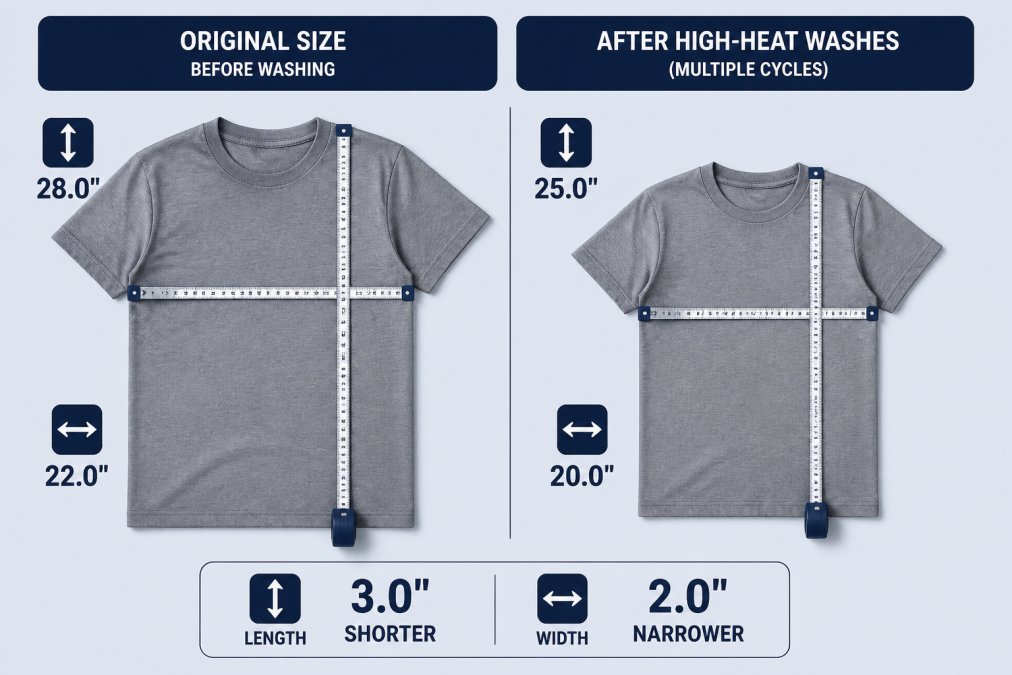
A Quick Visual Reference for Shrinkage
Here is what different shrinkage percentages actually look like on a standard men's tee, measured against a 28-inch body length and a 20-inch chest width:
| Shrinkage | Body length lost | Chest width lost | What it feels like |
|---|---|---|---|
| ~2% | About 1/2 inch | About 3/8 inch | Barely noticeable; sleeves feel slightly shorter |
| ~5% | About 1 1/2 inches | About 1 inch | Noticeably snugger; hem rides higher |
| ~8% | About 2 1/4 inches | About 1 5/8 inches | Roughly one size down in the torso |
| ~10%+ | About 3 inches | About 2 inches | A full size smaller; print may distort |
Untreated 100% cotton dried on high heat commonly lands in the 5-10% range over the first few cycles; pre-shrunk and garment-dyed cotton typically lands under 3%. The label matters more than the laundry routine.
Durable Christian Apparel for Men: What to Look For
Durable christian apparel for men starts with fabric weight and finishing, not branding. Heavier fabric holds its structure better, and garment-dyed or pre-shrunk cotton has already done most of its shrinking. Check four things:
- Fabric weight. Heavier knits resist distortion and hold their shape through more wash cycles.
- Fiber content. 100% ring-spun cotton or a cotton blend with controlled shrinkage.
- Construction details. Twill-taped neck and shoulders, double-needle hems, and a reinforced collar all extend garment longevity.
- Finishing method. Garment-dyed and pre-shrunk cotton offer better fit retention.
Dark Times Rebellion builds its tees around exactly these specs. The Hope is Forged Premium T-Shirt uses 100% ring-spun cotton at 6.1 oz/yd², garment-dyed for color depth, with a twill-taped neck and shoulders and double-needle hems at the armholes, sleeves, and bottom. That construction is what keeps a 2XL fitting like a 2XL after a season of washing.

Pre-Shrunk vs. Non-Pre-Shrunk Cotton in Heavyweight Tees
Pre-shrunk cotton has been washed or treated during manufacturing so most of its initial contraction happens before the shirt is cut and sewn. Non-pre-shrunk cotton skips that step, so the first few home washes do the shrinking instead.
The trade-off is straightforward: pre-shrunk cotton costs more and feels slightly firmer at first, but delivers predictable sizing, while non-pre-shrunk cotton feels softer out of the bag and then surprises you in the dryer. For a heavyweight tee you intend to keep, pre-shrunk or garment-dyed fabric is the safer choice.
How Christian Garment Construction and Screen Printing Affect Shrinkage
Screen printing changes how a shirt responds to heat. The ink layer cures at high temperature, which can pre-relax the fabric beneath the print, so printed areas sometimes shrink differently than unprinted ones, which is why a large front graphic can pucker or distort if you later dry the shirt on high heat.
Construction details matter just as much. Twill-taped neck and shoulder seams distribute weight and reduce stretching at stress points, double-needle hems resist the seam distortion that shows up first on cheaper tees, and a 7/8-inch double-needle topstitched collar holds its shape instead of rippling.
How to Shrink a Shirt That Is Too Large (And Stretch One That Shrank)
To shrink a cotton shirt, wash it in hot water and dry it on high heat, checking the fit after each cycle. To stretch a shirt that shrank, soak it in cool water with a small amount of conditioner, pull the fabric back to shape while damp, and lay it flat to dry. Both methods work best on 100% cotton; blends resist moving either way.
How Much Shrinkage to Expect, and Where It Happens
Cotton does not shrink evenly. Most change happens in length rather than width, because the yarns running the length of the garment carry more tension from knitting and relax more when heat and moisture release it. On a typical heavyweight tee, expect roughly twice as much length loss as width loss.
A realistic progression for an untreated 100% cotton tee dried on high heat:
- After one hot wash and hot dry: roughly 3-5% length loss, 2-3% width loss.
- After three cycles: roughly 5-8% length loss, 3-5% width loss.
- After five or more cycles: diminishing returns, with most of the total shrinkage already locked in.
A 30-inch body length can lose close to 2 inches over a handful of cycles. Check the shirt after every cycle, once it passes your target size, you cannot reverse it.
What Limits Shrinking (and Stretching)
Three things cap how far a shirt will move:
- Fiber content. 100% cotton moves the most. A 50/50 cotton-poly blend moves very little, because the synthetic fibers hold their shape and resist both contraction and stretching. Tri-blends, cotton, polyester, and rayon, sit in between and tend to shrink less than pure cotton but more than a 50/50.
- Finishing. Pre-shrunk and garment-dyed cotton have already been through a wet process, so they have far less room left to shrink. Trying to shrink a garment-dyed tee is usually a waste of hot water.
- Construction. Twill-taped neck and shoulder seams and double-needle hems resist distortion, which means they also resist the kind of uneven shrinking that makes a shirt look warped rather than simply smaller.
The Print Problem When You Shrink a Shirt
Shrinking a printed shirt can damage the graphic. When you wash hot and dry hot, the cotton contracts while the cured ink film does not. On a large plastisol print, that mismatch produces cracking, flaking, and edge lift; a water-based or discharge print flexes with the fabric and survives far better.
If you must shrink a printed tee, do it in stages: one hot wash and low dry, check the fit, then repeat only if needed. Never go straight to high heat on a shirt with a big front graphic.
Stretching a Shirt That Shrank
For stretching, work in small increments and never hang a damp shirt, which pulls the shoulders out of shape. Soak it in cool water with a capful of hair conditioner to relax the cotton fibers, pull it back to shape while damp, and lay it flat to dry. To stretch a specific area, a tight chest or short body, pin the damp shirt to a towel at the target dimensions and let it dry that way.
Be realistic about the ceiling: stretching recovers maybe an inch or two of length on a cotton tee, does not work at all on a 50/50 blend, and does not undo print cracking.
Frequently Asked Questions
Will a 2XL shrink to an XL?
A 2XL shrinking all the way to an XL is rare unless the shirt is non-pre-shrunk 100% cotton and gets washed in hot water then dried on high heat repeatedly. Most quality heavyweight tees lose 2-5% of their length after the first wash, which is roughly half a size. A 2XL typically stays a 2XL, just slightly snugger. Pre-shrunk or garment-dyed cotton, like the heavyweight tees from Dark Times Rebellion, is stabilized before it reaches you, so fit retention is much better.
Does cold water washing actually stop shrinkage?
Cold water washing slows shrinkage significantly but does not stop it entirely. Cotton fibers relax and contract when exposed to heat, so a cold water wash cycle keeps fiber tension stable and limits contraction. The bigger culprit is high heat drying. Pairing a cold water wash with air drying or low tumble dry is the most effective way to protect fit retention and fabric integrity over the life of the garment.
How should I wash heavyweight apparel to maintain its fit?
Turn the shirt inside out, wash on a cold, gentle cycle with like colors, and skip the fabric softener since it coats cotton fibers. Tumble dry on low or lay flat to air dry. Heavyweight ring-spun cotton holds its shape better than thin fabric, but high heat drying still breaks down fiber tension over time. Avoiding bleach and washing graphic tees inside out also protects any screen-printed design from cracking.
What fabric blends are most resistant to shrinking?
Cotton blends that include synthetic fibers like polyester or elastane resist shrinkage better than 100% cotton because synthetic fibers do not contract the way natural cotton fibers do under heat. A 60/40 cotton-poly blend may shrink less than 1% with proper care. However, 100% ring-spun cotton that is pre-shrunk or garment-dyed offers the best combination of softness, breathability, and dimensional stability for Christian apparel.