

Table of Contents
- Heavyweight Cotton vs Lightweight Cotton: The Longevity Gap
- What Is GSM in T-Shirts and Why It Decides Durability
- Fiber Quality and Weave: The Hidden Factors in Fabric Strength
- Why Heavyweight Cotton Holds Its Shape and Resists Wear
- The Environmental Case for Buying Fewer, Better Shirts
- How to Care for Heavyweight Cotton Shirts
- What to Look for When Buying a Heavyweight Tee
- Conclusion: Wear Your Convictions, Not Disposable Fabric
- Frequently Asked Questions
Last Updated: September 6, 2026
The average t-shirt in a fast-fashion rotation survives maybe thirty washes before the collar looks like a warped potato chip and the hem starts to roll. That isn't an exaggeration; it is the economics of a fabric engineered to be cheap rather than durable. When you ask why heavyweight cotton lasts longer, the answer lives in measurable textile specifications, not marketing language. Heavyweight cotton is a fabric weighing roughly 200 grams per square meter or more, and that density directly translates into structural staying power. At Dark Times Rebellion, we build our apparel around this principle, because a garment meant to carry conviction should not disintegrate after a season of wear.
Most guides on this topic stop at "thicker is better." The reality is more precise. Durability is a function of GSM, but also of fiber quality, weave construction, and how the fabric was finished. Below, we break down the actual mechanics of garment longevity so you can spot a genuinely durable heavyweight tee before you spend your money. We will also cover how to care for these shirts, because buying better means nothing if you wash them into an early grave.
Heavyweight Cotton vs Lightweight Cotton: The Longevity Gap
The most immediate difference between heavyweight cotton vs lightweight cotton is fabric density. Lightweight cotton, typically under 150 GSM, is prized for drape and breathability in hot weather. Heavyweight cotton, usually 180 GSM and above, trades some of that airiness for a fabric that holds its structure and resists the constant tugging and friction of daily wear.
That structural integrity is the core of the longevity gap. A lightweight shirt is more susceptible to fabric fatigue because there is less material to absorb stress. Each stretch at the shoulder, each rub against a seatbelt, concentrates force on fewer fibers. Over time, those fibers break down, leading to holes, thinning, and permanent bagging. A heavyweight fabric distributes that same stress across a denser network of yarns.
Here is what that means in practice for the wearer:
- Shape retention: Heavyweight cotton resists stretching out at the collar and shoulders.
- Wear and tear: The denser surface is less prone to pilling and abrasion damage.
- Opacity: No see-through moments, even in lighter colors.
- Cost-per-wear: A $30 shirt that lasts three years beats a $15 shirt that lasts six months.
The calculation is simple. You can buy three cheap shirts a year, or one quality shirt that outlasts all of them. For those who want a garment that stands for something, the choice is clear.
What Is GSM in T-Shirts and Why It Decides Durability
GSM stands for grams per square meter, and it is the standard unit for measuring fabric weight. What is GSM in t-shirts is a question of density: it tells you how much a square meter of that fabric weighs. The higher the number, the more yarn is packed into the fabric, and the heavier and generally more durable the result.
A standard, budget-friendly t-shirt often falls between 140 and 160 GSM. A mid-weight shirt sits around 170 to 190 GSM. A true heavyweight shirt starts at 200 GSM and climbs from there. For reference, the premium tees at Dark Times Rebellion use a 6.1 oz/yd² fabric, which converts to roughly 206.8 g/m². That places them firmly in the heavyweight category.
Why does this matter for durability? A higher GSM means a tighter, denser weave. There is more cotton to resist abrasion, more structural support to prevent stretching, and more material to hold a crisp shape wash after wash. A heavyweight shirt resists the deformation that ruins lighter garments because the fabric itself is simply more substantial.
This metric is the first thing to check when evaluating any t-shirt. If a brand does not list the GSM or fabric weight, ask. A brand that is proud of its construction will tell you exactly what you are buying.
Fiber Quality and Weave: The Hidden Factors in Fabric Strength
GSM tells you how much fabric is there, but not how good the cotton is. Two shirts can both weigh 200 GSM, yet one will last for years while the other falls apart. The difference is fiber quality and weave construction.
Fiber quality starts with the cotton itself. Look for shirts made from ring-spun or combed cotton. Ring-spun cotton is twisted into a finer, stronger yarn that is less likely to pill or break. Combed cotton goes a step further, removing short, weak fibers before spinning to leave only the long, durable strands. A shirt made from 100% ring-spun cotton, like the premium options at Dark Times Rebellion, will have a smoother hand feel and a stronger core than one made from loose, carded fibers.
The weave also matters. The warp and weft threads, the vertical and horizontal yarns, create the fabric's grid. A tight, consistent weave has fewer gaps and weak points. This is where textile construction separates a durable garment from a disposable one. The yarn count, or how fine the individual threads are, also plays a role; a higher yarn count often means a denser, more refined fabric.
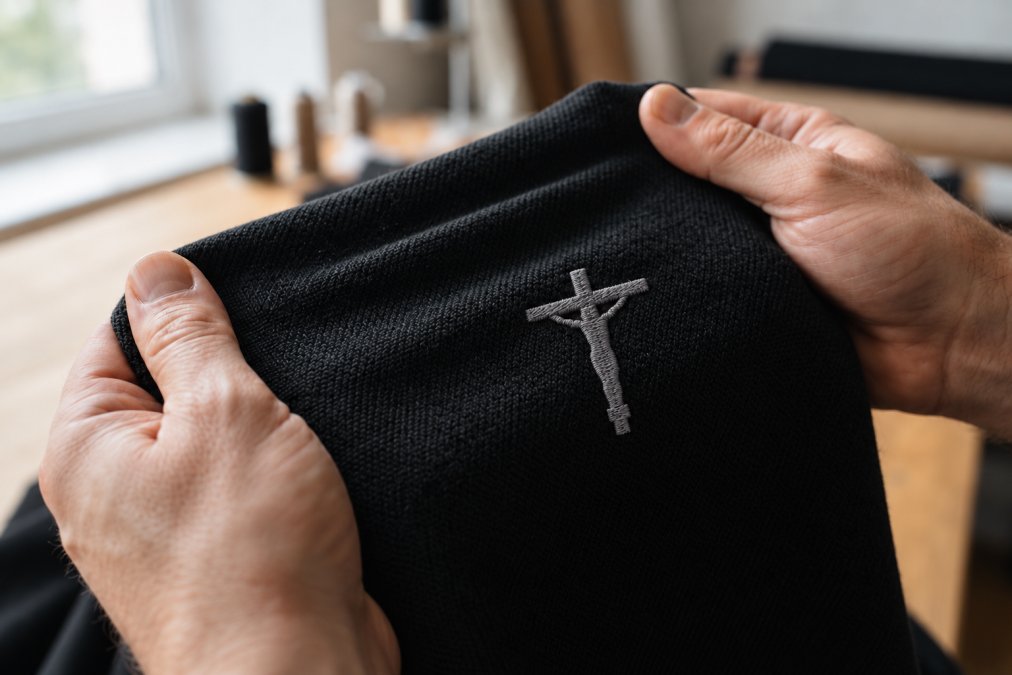
Close-up of hands holding and stretching a thick, premium black cotton t-shirt fabric, with an embroidered crucifix, showing the dense weave and texture under soft natural window light
Poly-blends are a common shortcut. Adding polyester makes a shirt cheaper and sometimes softer initially, but it can compromise breathability and lead to pilling over time. A high-quality 100% cotton heavyweight shirt is the benchmark for longevity.
Why Heavyweight Cotton Holds Its Shape and Resists Wear
The practical question is why heavyweight cotton does not sag, bag, or warp the way lighter fabrics do. The answer lies in tensile strength and fabric density. Tensile strength is the fabric's ability to resist breaking under tension. A heavier fabric has more yarns to share the load, giving it higher tensile strength and greater stretch resistance.
Consider the stress points on a t-shirt. The collar is constantly pulled over your head. The shoulders bear the weight of the fabric and your movement. The hem rubs against your waistband. A lightweight fabric fatigues at these points quickly. The collar loses its ribbed structure, the shoulders stretch into an unflattering droop, and the hem starts to roll.
Heavyweight cotton resists this fabric fatigue. The density of the weave holds the collar's shape, the structural integrity of the yarns prevents permanent stretching, and the overall thickness resists the friction that causes holes and thinning. This is why a good heavyweight tee looks nearly as good after fifty washes as it did on day one.
What most guides miss is the role of finishing. Garment-dyed fabrics, like those used in Dark Times Rebellion tees, are dyed after the shirt is sewn. This process can soften the fabric while maintaining its structure, and it often includes a pre-wash that minimizes shrinkage. A well-finished shirt will fit true to size and stay that way.
The Environmental Case for Buying Fewer, Better Shirts
The durability argument is not just about your wallet; it is about the planet. The fashion industry is a major contributor to waste, with millions of tons of clothing ending up in landfills each year. The concept of slow fashion pushes back against this cycle, advocating for buying fewer, higher-quality items that last longer.
A heavyweight cotton shirt is a slow fashion purchase. Because it lasts for years instead of months, it reduces the demand for constant replacement. This lowers your personal consumption footprint and keeps garments out of landfills. The environmental cost of producing one quality shirt is spread over a much longer lifespan than a cheap, disposable alternative.
This aligns with the broader principles of stewardship. Buying a garment built to last is a more responsible choice than feeding the churn of disposable fashion. It is a rejection of the idea that clothing should be temporary.
How to Care for Heavyweight Cotton Shirts
Buying a durable shirt is only half the battle. How to care for heavyweight cotton shirts determines whether you get two years or five years out of them. The biggest enemy of any cotton garment is heat and aggressive washing.
Follow these steps to maximize the life of your heavyweight tees:

- Wash in cold water. Hot water accelerates fiber breakdown and causes shrinkage. Cold water cleans effectively without the damage.
- Turn the shirt inside out. This protects the outer surface from friction and fading during the wash cycle.
- Air dry when possible. The heat of a dryer is brutal on cotton fibers and is a leading cause of shrinkage and fabric fatigue. Hang drying is gentler and preserves the fit.
- Avoid harsh detergents and bleach. These strip the natural oils from the cotton and weaken the fibers over time.
- Do not over-wash. Unless the shirt is visibly dirty or sweaty, it does not need to be washed after every single wear. Spot cleaning is often enough.
The "shrinkage" complaint you hear about premium cotton is usually a care issue, not a manufacturing defect. A garment-dyed, pre-washed shirt will have already done most of its shrinking. Your job is to not undo that work with a hot dryer.
What to Look for When Buying a Heavyweight Tee
Not all heavyweight shirts are created equal. When you are shopping, use a checklist to separate genuinely durable construction from a heavy fabric that will still fall apart. The label tells you more than the marketing copy.
Feature |
What to Check |
Why It Matters |
|---|---|---|
Fabric Weight |
200 GSM or higher (6 oz/yd²+) |
Indicates true heavyweight density |
Fiber Content |
100% cotton, ring-spun or combed |
Stronger, smoother, less pilling |
Collar |
Double-needle topstitched, twill-taped |
Reinforces the first point of failure |
Seams |
Double-needle armhole, sleeve, and hem |
Prevents seam failure and rolling |
Finishing |
Garment-dyed, pre-washed |
Minimizes shrinkage, softens fabric |
A shirt that checks all these boxes is built to last. A shirt that only lists a high GSM but uses loose, carded cotton and single-needle seams will still disappoint you. The construction details matter as much as the weight.
For those who want a shirt that carries a message as durable as its fabric, the collection at Dark Times Rebellion is built on these exact specifications. The premium heavyweight tees use 100% ring-spun cotton at a substantial weight, with reinforced collars and double-needle hems. They are designed for the long haul, because a statement of faith should not fade after a few washes.
Conclusion: Wear Your Convictions, Not Disposable Fabric
The question of why heavyweight cotton lasts longer has a clear answer: density, fiber quality, and construction. A heavyweight shirt resists the wear and tear that destroys lighter fabrics, holds its shape through countless washes, and offers a cost-per-wear that makes it the smarter investment. It is also the more responsible choice for a world drowning in textile waste.
The temptation to buy cheap and buy often is strong, but it is a false economy. A garment that falls apart in six months is not a bargain; it is a liability. Choosing a heavyweight shirt is a decision to value quality over quantity, durability over convenience, and longevity over disposability.
At Dark Times Rebellion, we believe what you wear should reflect what you stand for, and it should stand up to the fight. Our heavyweight tees are crafted to endure, just like the faith they represent. When you choose a shirt built to last, you are making a statement that goes beyond fashion.
Frequently Asked Questions
Is 100% heavyweight cotton more durable than lightweight blends?
Yes, in most cases. Heavyweight cotton, typically 6 oz/yd² or higher, has more fiber mass per square yard than lightweight fabrics. This density creates a stronger barrier against friction, stretching, and tearing. Polyester blends can resist wrinkles, but they often pill and degrade faster than quality cotton. A 100% heavyweight cotton shirt with ring-spun fibers will outlast a lightweight blend because the thicker yarns and tighter weave hold up better to repeated washing and daily wear.
Does heavyweight cotton shrink a lot?
Heavyweight cotton can shrink, but quality brands control this during manufacturing. Garment-dyed heavyweight shirts like those from Dark Times Rebellion are pre-shrunk during the dyeing process, which prevents most future shrinkage. To minimize any remaining risk, wash your heavyweight shirts in cold water and hang them to dry or use low heat. High heat is the main culprit behind cotton shrinkage, so keeping temperatures low preserves the fabric's structural integrity and shape retention.
What does GSM mean and what is a good GSM for a t-shirt?
GSM stands for grams per square meter, the standard measurement of fabric weight. A standard t-shirt ranges from 150 to 180 GSM, while heavyweight shirts start around 200 GSM and go up to 250 GSM or more. For a shirt that lasts, look for at least 200 GSM. Higher GSM means denser fabric, which translates to better durability, shape retention, and a more substantial hand feel. Dark Times Rebellion shirts are 206.8 g/m², putting them firmly in the durable heavyweight category.
Is heavy cotton considered higher quality than thin cotton?
Generally, yes, but weight alone doesn't define quality. Heavyweight cotton signals quality because it uses more material and typically better construction methods like ring-spun or combed yarns. However, fiber quality matters just as much. A heavyweight shirt made from low-grade fibers can still fail. Look for heavyweight fabric combined with quality markers like ring-spun cotton, double-needle stitching, and taped seams. These features together indicate a garment built for long-term wear, not just a thick piece of fabric.