

Table of Contents
- Start With the Fabric: The Foundation of Quality Christian Streetwear
- Why Heavyweight Christian T-Shirts Outlast Thin Alternatives
- Inspect the Construction: Stitching, Seams, and Stress Points
- Print Quality: How to Tell If a Graphic Will Crack or Fade
- Fit, Sizing, and Wearability: What Quality Christian Streetwear Should Feel Like
- How to Wash Graphic T-Shirts So They Last for Years
- Faith-Message Integrity: Reading the Heart Behind the Design
- Conclusion: Wear Your Faith With Confidence
- Frequently Asked Questions
Last Updated: October 5, 2026
Start With the Fabric: The Foundation of Quality Christian Streetwear
Spotting quality christian streetwear starts with the fabric, not the graphic. The fabric decides whether a piece survives a year or falls apart by month three.
At Dark Times Rebellion, we build on heavyweight, garment-dyed cotton because it outlasts cheap alternatives. Here is what to check before you buy.
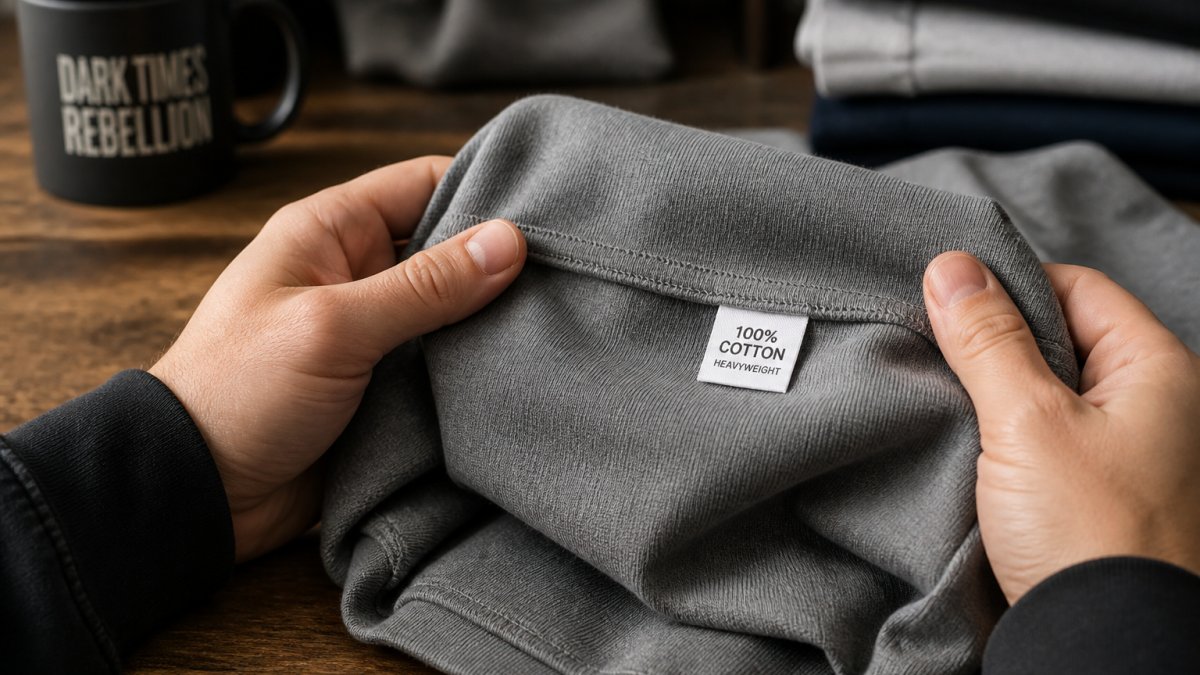
How to Tell If a T-Shirt Is Good Quality Using Weight and Hand Feel
Fabric weight, measured in GSM (grams per square meter), is the best quality signal you can check without a lab. Heavier fabric holds its shape, drapes better, and resists the see-through look of cheap shirts. Here is what to expect:
| Fabric Weight | Feel | Best For |
|---|---|---|
| Under 150 GSM | Thin, sheer | Disposable basics |
| 150-180 GSM | Light, average | Warm-weather layering |
| 180-210 GSM | Substantial, structured | Year-round daily wear |
| 210+ GSM | Heavy, premium | Durability and warmth |
Our tees use 6.1 oz/yd², about 207 GSM.
Squeeze the fabric: good cotton springs back; cheap cotton stays wrinkled and feels slick or papery.
Do not assume softness equals quality, very soft, thin cotton wears out fast. You want cotton that feels dense and slightly rough at first, then softens with washing.
Ring-Spun vs. Open-End Cotton: What the Label Won't Tell You
Ring-spun cotton twists fibers into a fine, strong yarn for a smoother, more durable fabric. Open-end cotton is made faster and cheaper, producing a rougher yarn that pills and thins faster.
The problem: most labels just say "100% cotton" and rarely name the method.
How can you tell the difference in person?
- Ring-spun fabric feels smoother with a tighter weave and holds print detail more cleanly
- Open-end fabric looks fuzzier, feels rougher, and shows more surface lint over time
Our heavyweight tees use 100% ring-spun cotton, which keeps prints sharp and resists pilling.

Why Heavyweight Christian T-Shirts Outlast Thin Alternatives
Heavyweight Christian T-shirts last longer because thicker cotton resists stretching, thinning, and seam failure.
The Three Mechanisms That Decide How Long a Tee Lasts
Durability comes from three things, and a shirt can be strong in one and weak in another:
- Yarn density: More cotton per square inch means less wear-through, hold a cheap tee to a window and you can see your hand.
- Fabric weight: Heavier fabric absorbs stress instead of tearing.
- Knit tightness: Tighter knits resist stretching at the neck and hem.
A heavy but loosely knit shirt still bags out; a tight but thin shirt still wears through at the elbows.
Shrinkage: The Number Most Brands Hide
Cotton shrinks. The only question is how much, and whether the brand planned for it.
- Ring-spun, garment-dyed, or pre-shrunk cotton typically shrinks 2-5% in length after the first wash.
- Unwashed or tube-knit cotton can shrink 5-10%, enough to turn a medium into a small.
- Cotton-polyester blends shrink less but pill faster and hold odor longer.
A quality brand publishes shrinkage expectations or cuts the garment slightly long.
Cost Per Wear: The Only Price Comparison That Matters
Price alone tells you nothing: a $60 tee lasting three years costs less per wear than a $20 tee lasting six months. Run the math before deciding a higher price is unjustified.
Cost per wear = Price ÷ (Wears per year × Years of useful life)
- A $20 tee worn twice a week for six months = about 52 wears = roughly $0.38 per wear.
- A $60 tee worn twice a week for three years = about 312 wears = roughly $0.19 per wear.
The cheap shirt looks cheaper at checkout and costs more over time.
What Heavyweight Does Not Fix
Heavyweight cotton is not automatically better in every situation:
- Hot, humid climates: A 240 GSM tee can feel oppressive in July. A 180-200 GSM ring-spun tee breathes better than a 150 GSM polyester blend because cotton moves moisture instead of trapping it.
- Layering under jackets: Very heavy tees bunch at the shoulders.
- Athletic use: Heavyweight cotton holds sweat.
How to Test Durability in 60 Seconds
You cannot wash a shirt in the store, but four quick checks predict how it will age:
- Stretch the collar. If it stays stretched, the ribbing is weak and the neck will sag.
- Pinch and release the fabric. Good cotton springs back; cheap cotton stays wrinkled.
- Hold it to the light. If you can read text through it, the knit is too loose for daily wear.
- Tug a side seam. If you hear threads popping, the seam allowance is too narrow.
All four take under a minute and predict more about a shirt's lifespan than any marketing copy.
Inspect the Construction: Stitching, Seams, and Stress Points
Quality construction shows up in the stitching. Turn the shirt inside out, this is where cheap brands cut corners and where you can spot problems before they become holes.
Check these stress points:
- Collar: Double-needle topstitching, not a single thin line
- Shoulders: Twill tape along the seam for reinforcement
- Armholes and hems: Double-needle stitching prevents splitting
Run your thumb along the inside of the collar: a quality collar has a taped or reinforced edge.
Our tees use twill-taped neck and shoulders plus double-needle armhole, sleeve, and bottom hems, so the shirt holds its shape instead of drooping.
Here is a quick garment-inspection checklist you can use in any store:
- Fabric weight listed as 180 GSM or higher
- Collar has double-needle topstitching
- Shoulder seams are taped or reinforced
Print Quality: How to Tell If a Graphic Will Crack or Fade
Print quality decides whether your faith-based message still looks sharp after a year. The print method matters more than the design itself.
Three common methods dominate the market:
- Screen printing: Thick ink laid into the fabric. Durable but can feel heavy
- Direct-to-garment (DTG): Ink sprayed onto the surface. Great detail, but fades faster
- Heat transfer: Vinyl pressed onto fabric. Cheap and prone to peeling
Screen printing on heavyweight cotton lasts longest because the ink bonds with the fabric.
How to test a print before buying:
- Stretch the fabric where the graphic sits. If the print cracks, it will fail
- Feel the print. A good print feels like part of the shirt, not a plastic layer
- Check design placement. A centered print that follows the chest curve wears better
A common mistake is a huge print on thin fabric.
Hope is Forged - Premium T-Shirt - Grey →
The best print is one you can barely feel.
Fit, Sizing, and Wearability: What Quality Christian Streetwear Should Feel Like
Fit is where most online apparel purchases go wrong.
Here is how to judge fit before you commit:
- Shoulders: The seam should sit at the edge of your shoulder, not below it
- Chest: Enough room to move without pulling across the chest
- Length: Should hit mid-hip, not ride up when you raise your arms
Bigger buyers get burned most often: a true 2XL should measure 26 inches across the chest, not 24.
Our relaxed-fit tees run S to 4XL with published measurements, a 2XL measures 26 inches wide and 31 ⅝ inches long.
Wearability also means versatility: a quality piece should work with jeans, joggers, or layered under a jacket.
How to Wash Graphic T-Shirts So They Last for Years
Washing is where good shirts go to die.
Follow these rules to make a quality tee last:
- Turn it inside out before washing to protect the print
- Wash cold on a gentle cycle. Heat breaks down cotton fibers and print ink
- Use mild detergent. Harsh bleach and fabric softener damage cotton
- Skip the dryer or use low heat. High heat shrinks cotton and cracks prints
- Hang dry in the shade to keep colors from fading
- Iron inside out on low if needed. Never iron directly on the print
A quality shirt washed this way lasts years.
Faith-Message Integrity: Reading the Heart Behind the Design
The message matters as much as the material. A quality Christian apparel brand treats the faith side seriously, not as a marketing gimmick, and you can verify it the same way you verify fabric weight or stitch quality.
Step 1: Check the Scripture, Not Just the Slogan
A design can quote a verse and still misuse it. Before you buy, look up the reference and read the surrounding passage.
- Is the citation accurate? A shirt that says "Jeremiah 29:11" but paraphrases it loosely is using Scripture as decoration, not communication.
- Is it in context? Verses pulled from a promise to Israel and pasted onto a fitness slogan often lose their original meaning.
- Is the translation credited? Quality brands name the translation (ESV, NASB, KJV, NIV) or label their own paraphrase as such. Uncredited quotes are a yellow flag.
This is not gatekeeping, it is the same standard you would apply to any product making a factual claim.
Step 2: Read the Brand's Mission Page Like a Contract
A mission statement is only useful if it makes specific, checkable commitments. Compare two kinds of language:
- Vague: "We exist to spread the Gospel through fashion."
- Specific: "Ten percent of every order funds [named ministry], and we publish an annual giving report."
The second can be verified; the first cannot. Look for:
- A named giving partner, ministry, or fund
- A stated percentage or dollar commitment
- A published report, receipt, or update
If a brand claims to give but never says how much or to whom, treat it as marketing until proven otherwise.
Step 3: Assess Sourcing and Labor Transparency
This is the gap almost no Christian streetwear brand addresses, and it matters.
Ask these questions of any brand you consider:
- Does the product page name the mill, factory, or country of manufacture? "Imported" alone tells you nothing.
- Does the brand publish a supplier list or code of conduct? Even a short one is a signal.
- Are certifications mentioned? Look for recognized programs like Fair Trade Certified, WRAP, or OEKO-TEX, which verify labor and chemical safety standards.
You do not need a perfect supply chain, you need a brand willing to talk about it.
Step 4: Match the Message to Your Own Walk
A Christ-centered message should feel like a visual parable, not a slogan slapped on a shirt. The right design depends on how you actually live:
- For work or school: Subtle typography or a symbol reads as personal style, not a billboard.
- For church or ministry events: A clear verse reference invites conversation.
- For everyday wear: A design that sparks a question is more effective than one that answers it before anyone asks.
Bold is not the same as preachy, a subtle design can carry as much weight as a loud one. The question is whether the message reflects your walk and sparks honest questions.
Red Flags and Green Flags
A quick comparison to keep in mind while shopping:
| Red Flag | Green Flag |
|---|---|
| Verse quoted without reference | Translation and reference both cited |
| "We give back" with no details | Named partner and stated percentage |
| "Imported" with no country | Mill or factory named |
| No founder or team visible | Named team with public presence |
| Design explained only as "inspirational" | Design story tied to a specific passage |
Brands that care about the faith side explain their mission and stand behind their work. Dark Times Rebellion exists to help believers stand firm against the darkness, and every design ties back to that purpose. Our pieces are a silent testimony, not a performance, and we welcome the same questions we ask you to ask of anyone.
Conclusion: Wear Your Faith With Confidence
Spotting quality christian streetwear comes down to a few checks: fabric weight, ring-spun cotton, reinforced stitching, and a print that bonds with the fabric.
The harder question is the message. A shirt should carry your faith with purpose, not just look good.
Our heavyweight tees use 100% ring-spun cotton at 6.1 oz/yd², with twill-taped shoulders and double-needle hems for real durability.
Enter the Rebellion and wear your commitment to the Light with apparel built to last.
Frequently Asked Questions
How can I tell whether a graphic print will last on Christian streetwear?
Check the print method and how it sits on the fabric. Screen-printed graphics should feel bonded to the surface, not like a thick plastic layer that peels at the edges. Look for ink that flexes with the cotton without cracking. A quality print on heavyweight Christian T-shirts, like those with 6.1 oz/yd² fabric, holds up through dozens of washes when cared for properly.
What fabric should I look for in durable Christian apparel?
Look for 100% ring-spun cotton with a fabric weight of at least 6.1 oz/yd² (206.8 g/m²). Ring-spun cotton creates a softer, stronger yarn than standard cotton. Heavier fabric resists thinning and holds its shape after repeated washing. Garment-dyed options also tend to keep their color better over time compared to piece-dyed alternatives.
How should I wash graphic T-shirts to keep them looking good?
Turn the shirt inside out before washing to protect the print. Use cold water on a gentle cycle, and avoid fabric softener because it can break down the ink bond. Tumble dry on low or hang dry. Following these steps on a heavyweight Christian T-shirt helps the graphic stay sharp and the cotton stay soft for years of regular wear.
Is Christian streetwear appropriate for church?
Yes, when the design and fit suit the setting. Many churches welcome faith-based clothing that expresses conviction without distraction. A clean, minimal design or a Scripture-inspired message on a well-fitted heavyweight tee works in most casual church environments. The key is choosing a piece that points to the message rather than pulling attention to the wearer.